
By Jennifer Vafakos, ERYT-500, YACEP | Lead Instructor and Owner, Inlet Yoga Studio, Manasquan, NJ
That dull, heavy ache sitting between your shoulder blades has been there so long, you have almost stopped noticing it. Almost. It shows up when you reach for something on a high shelf, when you try to turn your head while reversing the car, and especially at the end of a long workday when your neck feels like it has been poured into concrete. I hear this from new students at Inlet Yoga in yoga class for beginners every single week. The good news is that the fix is simpler than most people expect, and it starts the moment you roll out a mat.
Why Your Shoulders Are So Tight in the First Place
Before we talk about solutions, it helps to understand what is actually happening in your body. When you sit at a desk for hours, two specific muscle groups take the brunt of the damage. Your upper trapezius and levator scapulae, the muscles running from the base of your skull down to your shoulder blades, stay in a constant low-level contraction to hold your head forward over a screen. Research published by Yoga Journal explains that when your head juts forward, the levator scapulae and upper trapezius have to contract continuously to hold it up, while the muscles that should stabilize your shoulder blades, including the rhomboids and lower trapezius, gradually switch off and weaken. That imbalance is the source of the burning, locked sensation most desk workers feel by midday. Yoga Journal
The muscles at the front of your chest, particularly your pectoralis minor, also shorten from being in a hunched position all day. This pulls your shoulders forward and inward, creating a rounding that puts even more strain on the back of your neck. By the time you leave the office, your entire upper body is essentially fighting itself.
What Happens Inside Your Body During a Beginner Yoga Session
A yoga class for beginners works on this problem from multiple angles at once, and that is precisely why it is more effective than simply stretching at your desk or rolling a tennis ball on the floor.
A study published in the Journal of Orthopaedic and Sports Physical Therapy measured muscle activation during yoga postures using electromyography and found that specific poses generated meaningful activation in the upper, middle, and lower trapezius, as well as the serratus anterior, all muscles critical to healthy shoulder function. In plain terms, yoga is not passive stretching. It is actively waking up muscles that have gone quiet while simultaneously releasing the ones that are overworking. Journal of Orthopaedic & Sports Physical Therapy
In our beginner yoga classes at Inlet Yoga, we focus on a handful of foundational movements that target the exact areas desk workers struggle with most. Here is what each one does for your shoulders:
Thread the Needle releases the subscapularis and posterior capsule of the shoulder joint. This is the movement that melts the sharp, pinching sensation many people feel between the shoulder blades when they try to rotate their arms.
Cat-Cow decompresses the cervical and thoracic spine, taking pressure off the nerve roots that can cause the tingling or referred pain that travels down your arm from a tight neck.
Eagle Arms stretches the rhomboids and the back of the rotator cuff, two areas that chronically tighten in people who type for a living. Students regularly tell me this is the first stretch they have ever felt actually reach the problem spot.
Supported Fish Pose opens the pectoralis minor and anterior deltoids, reversing the forward-rounding position your body defaults to after hours in a chair. Opening the chest is not just about posture; it directly reduces the tension load on your neck.
Locust Pose (modified) builds the lower and middle trapezius, the stabilizers that hold your shoulder blades flat against your back. Strengthening these muscles is what creates lasting relief rather than temporary loosening.
Why Beginner Yoga Classes Work When Nothing Else Does
Most people who come to us have already tried everything. They have used foam rollers, booked a few massages, and set hourly reminders to stretch at their desks. These things help temporarily, but the tightness always comes back. The reason is that muscle tension in the shoulders is only partly a physical problem. The other part is neurological.
When your body stays in a stress response, your nervous system tells your muscles to stay contracted as a protective mechanism. Slow, rhythmic movement paired with deliberate breathing directly signals the parasympathetic nervous system to downregulate that protective tension. This is not a wellness cliche. It is the mechanism behind why people walk out of their first beginner yoga class standing taller and breathing deeper than when they walked in, even before any significant flexibility has developed.
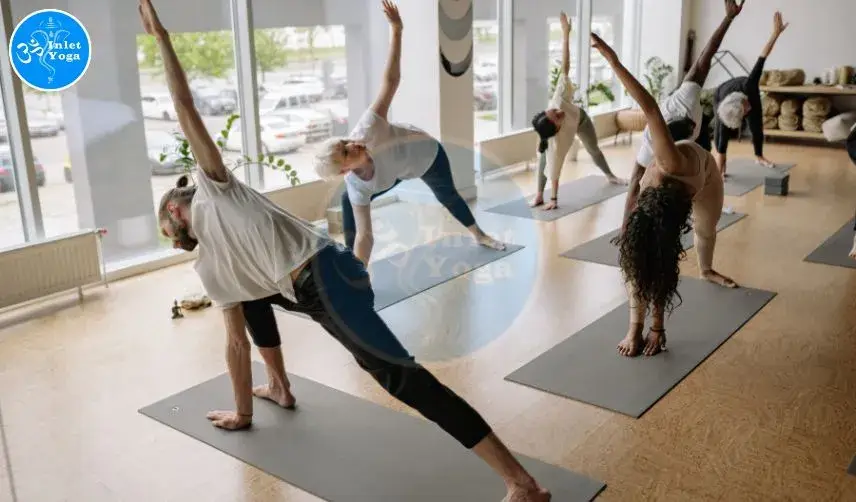
Our beginner yoga classes at Inlet Yoga are specifically designed so that you never have to worry about keeping up or looking out of place. The pace is slow, the poses are always adaptable, and every instructor gives you individual attention to make sure the movement actually lands in the right place. There is nothing worse than stretching a muscle that is already overstretched, and we make sure that never happens.
If you want a more tailored experience as you start out, our private yoga sessions let you work one-on-one with an instructor who can assess your specific movement patterns and design a short sequence built entirely around your shoulders and neck. Many students combine one private session with regular group classes and see results much faster.
What to Expect After Your First Few Sessions
The first session almost always produces immediate relief. Your shoulders drop, your breath deepens, and you notice a warmth in your upper back where there was previously only tightness. Most students describe it as the first time their shoulders have felt like they belong to their body in years.
After two to three weeks of attending beginner yoga classes twice a week, the changes become structural. Your posture shifts without you having to think about it. The tension headaches that crept in every afternoon start to arrive less frequently. Reaching, turning, and lifting become movements you do without bracing for pain.
If this is something you have been wondering about alongside your physical wellbeing, our post on how yoga classes for beginners help with emotional balance explains the deeper connection between releasing physical tension and improving your mood and mental clarity.
Frequently Asked Questions
Can a yoga class for beginners help if I am extremely stiff and inflexible?
Yes, and in fact stiff bodies often respond fastest. Our beginner classes are built for tight muscles, not flexible ones. Every pose is offered with modifications so you work at a depth that feels productive, not painful.
How many sessions before I notice a real difference in my shoulders?
Most students feel meaningful relief after their very first class. Attending twice a week for three to four weeks creates changes that stick because you are retraining both the muscle and the nervous system, not just stretching temporarily.
Do beginner yoga classes help with tension headaches?
Yes. A large portion of tension headaches originate from the levator scapulae and upper trapezius. Releasing these muscles consistently reduces the frequency and intensity of stress headaches significantly.
What should I wear or bring to my first class?
Comfortable, stretchy clothing you can move freely in. We provide mats, blocks, straps, and blankets so you do not need to bring any equipment on your first visit.
Is beginner yoga at a yoga studio in New Jersey suitable for desk workers with chronic neck pain?
It is one of the best tools available for exactly this problem. Our classes are attended by teachers, nurses, remote workers, and anyone whose daily routine keeps them in a fixed position for extended periods. You will be in good company.
Your Shoulders Have Waited Long Enough
Living with daily shoulder tightness is not something you have to keep managing, one massage or ibuprofen at a time. The problem has a real solution, and it is available to you right now.
Join us at Inlet Yoga in Manasquan, NJ and experience what it feels like to move without bracing, sit without aching, and end your day with your shoulders where they belong. Our New Student Offer gives you 5 Classes for $49, so you can try different classes with zero pressure.
Claim Your 5 Classes for $49 and Start Feeling the Difference






