One of the most profound lessons we can learn from yoga is that the breath is not just something we carry along with us — it’s the very medium through which we explore, connect, and awaken.
On the mat, the breath is what allows us to meet each shape fully, with steadiness and spaciousness.
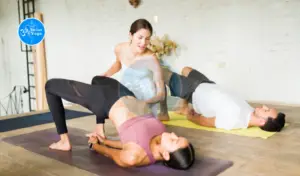
And when we come together in practice, breathing as one, it becomes something even more extraordinary: a shared rhythm that reminds us we are more deeply connected than we realize — in yoga and in life.
Breathing Into the Shape: The Breath as a Guide in Asana
Every yoga shape asks something different of us — grounding, opening, stabilizing, softening — and the way we direct our breath can support what the shape needs.
The breath is directional. It illuminates and nourishes wherever you place it — belly, ribs, back body, or even upper chest.
Here’s how to consciously use your breath to explore asana more fully:
Breath in Different Shapes
Grounding & Forward Folds
-
Breath: Lower belly and lower ribs
-
Why: Grounds the pelvis, quiets the nervous system, releases the spine.
-
Examples: Seated forward fold, child’s pose.
Expansive & Backbends
-
Breath: Side ribs, back lungs, and upper chest
-
Why: Creates space in the heart, lengthens the spine.
-
Examples: Cobra, camel, upward dog.
Twists
-
Breath: Side ribs and back body
-
Why: Maintains spinal length and space between vertebrae.
-
Examples: Seated spinal twist, revolved triangle.
Balance
-
Breath: Lower ribs with subtle core engagement
-
Why: Stabilizes your center and calms the mind.
-
Examples: Tree, half moon, standing balances.
Inversions
-
Breath: Lower ribs and back body
-
Why: Keeps the core engaged while calming the nervous system.
-
Examples: Shoulderstand, headstand, handstand.
A Practice Tip
In every pose, ask yourself:
Where does this shape need breath? Where could my breath create space, stability, or ease?
When you let your breath lead the way, the posture becomes less about “doing” and more about listening, exploring, and connecting.
The Collective Breath: Why It Matters in Yoga and Life
In a vinyasa class, there often comes a moment — soft but unmistakable — when the room begins to breathe as one.
At first, everyone’s breath is personal, disorganized, and inward. But as the practice unfolds, the cadence steadies, and the sound of inhales and exhales begins to weave through the room, pulling everyone into the same rhythm.
This is the collective breath — the moment when we stop being just individuals sharing space and become something more:
We are not just individuals sharing space — we are a living, breathing web of connection.
Why It Matters
When the room breathes together:
-
The group feels calmer, more cohesive.
-
Students feel supported and less alone, even in a challenging posture.
-
A subtle empathy arises — the ability to attune to those around us.
-
The energy of the practice elevates into something ceremonial, even sacred.
This phenomenon, called entrainment, happens because we are wired to sync with one another when we share intention and presence.
Beyond the Mat
When we practice breathing with others, we train ourselves to notice, listen, and attune — skills that ripple into our daily lives:
-
We become more patient in conversation.
-
We sense others’ moods and needs more easily.
-
We carry ourselves with more steadiness, even in the face of conflict or stress.
-
We feel less isolated and more rooted in the larger web of humanity.
Every time you guide your students to breathe together, you’re not just teaching them yoga. You’re gently awakening their innate ability to attune — to really see, hear, and feel one another — in all the moments of their lives.
Closing Reflection
The next time you step onto your mat, let your breath lead you into each shape — illuminating the space your body needs to open, ground, or stabilize.
And when you find yourself breathing alongside others, let the sound of their breath remind you that you are held in something larger — a living, breathing web of connection.
Because the way we breathe — on and off the mat — can truly change how we move through the world.
Frequently Asked Questions (FAQs)
- What makes a beginner yoga class different from regular classes?
A beginner yoga class focuses on foundational poses, proper alignment, breath awareness, and step-by-step guidance to prevent mistakes and build confidence. - How quickly can I expect to see improvement in my practice?
With consistent attendance, many beginners notice better balance, posture, and awareness within a few weeks, as guided practice helps avoid common errors. - Do I need any special equipment for a beginner yoga class?
Most classes provide basic guidance, and simple props like a yoga mat, blocks, or straps can help with alignment and safety during poses. - Can I attend a beginner yoga class if I’m not very flexible?
Absolutely. Beginner classes are designed for all fitness and flexibility levels, offering modifications to ensure safe practice without strain. - How does attending a local studio like Inlet Yoga help prevent mistakes?
Being in a supportive environment with experienced instructors allows immediate corrections, personalized guidance, and consistent feedback, helping you avoid errors and practice safely.