
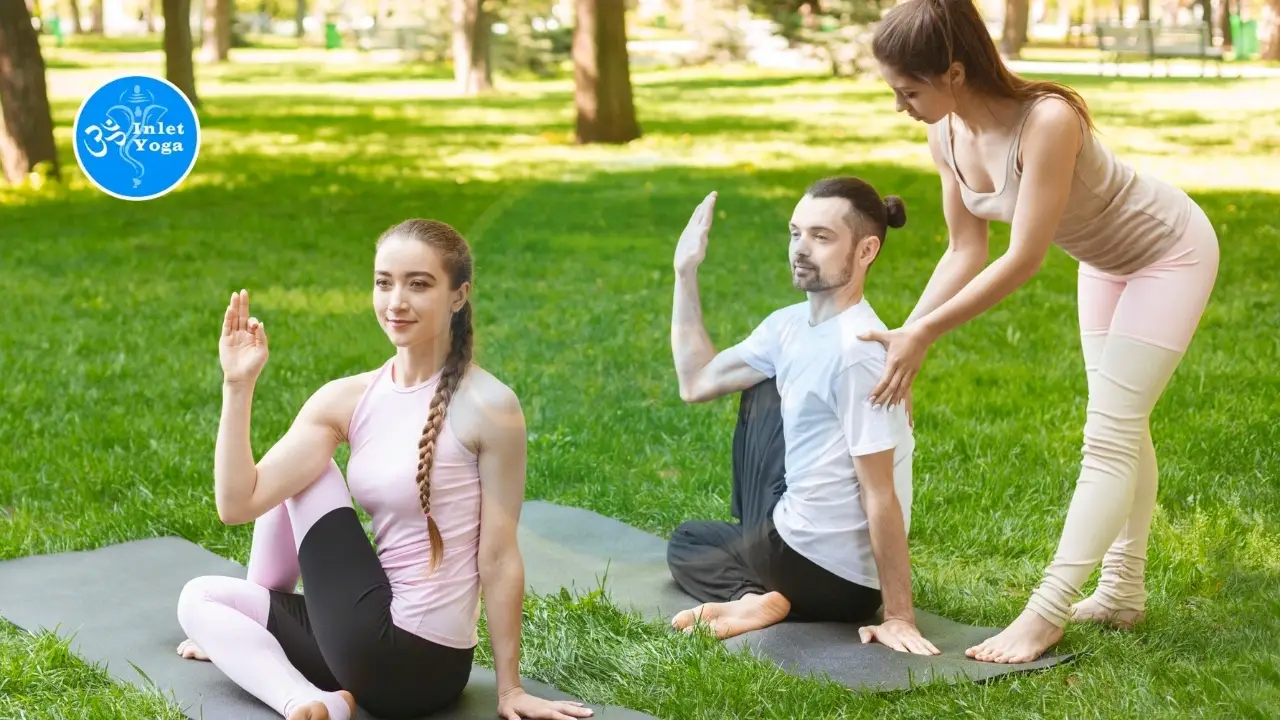
The most common yoga mistakes shift as your practice develops. Beginners tend to pick the wrong class level, avoid props, or copy how a pose looks instead of how it should feel. Intermediate students tend to get too comfortable: skipping warm-ups, chasing depth before building control, or dropping props too soon.
A few pose-specific mistakes also come up often, like rounding the back in Downward-Facing Dog or letting the front knee collapse in Warrior II. Sharp pain, numbness, or lingering soreness is a sign to check in with an instructor or doctor rather than push through. The sections below cover each mistake in detail.
Most yoga mistakes aren’t about flexibility or strength. They’re about habits: rushing a pose, ignoring a warning sign from your body, or holding your breath without noticing. And the mistakes don’t stay the same as you progress. A beginner and an intermediate student can walk into the same class and make completely different errors, even in the same pose.
At Inlet Yoga in Manasquan, NJ, our instructors see these patterns every week, across every level. Here’s what we notice most often, why it happens, and how to fix it safely.
Why Common Yoga Mistakes Change as Your Practice Develops
When you’re brand new to yoga, most common yoga mistakes come from not knowing yet. You might not recognize proper alignment, you might be unsure when to use a prop, or you might just be following the person next to you instead of your own body.
Once you’ve been practicing for a while, the mistakes shift. Intermediate students usually know the poses. Their errors tend to come from comfort and overconfidence instead: skipping warm-up cues because a pose feels familiar, chasing a deeper variation before the foundation is solid, or assuming that because a pose used to feel fine, it always will.
Neither stage is “better” or “worse.” They’re just different, which is why the same class can produce very different habits depending on who’s on the mat.
| Student Level | Common Pattern | Best Fix |
| Beginner | Copies pose shape, avoids props, picks the wrong class | Start slower, use props, and ask questions |
| Intermediate | Rushes transitions, skips basics, or chases depth too soon | Rebuild control, slow down, and refine alignment |
| Flexible student | Goes deeper into poses without enough strength or stability | Add engagement cues and build stability |
| Returning student | Practices like nothing has changed after time away | Modify the practice based on how the body feels today |
1. Choosing a Yoga Class That Does Not Match Your Level
This is one of the most common yoga mistakes we see, and it usually happens before class even starts.
Mistakes Beginners Make
New students often pick a class based on the time slot that fits their schedule rather than the level that fits their body. Jumping into a fast-paced flow class on day one can leave you guessing your way through poses you’ve never learned, which raises your risk of strain and makes the whole experience more stressful than it needs to be.
Mistakes Intermediate Students Make
Intermediate students make the opposite mistake. They stay in a beginner-level class long after they’ve outgrown it, or they jump straight to an advanced class because they’re bored, without building the strength and control the harder class actually requires. Either way, the class stops matching what your body is ready for.
If you’re unsure which level fits you right now, matching a class to your actual goal is a better starting point than picking whatever fits your schedule.
2. Trying to Make Every Yoga Pose Look Perfect
A pose that looks “perfect” on someone else’s body isn’t necessarily correct for yours. Bodies differ in proportion, joint structure, and flexibility, so the same pose can look completely different from one student to the next and still be done safely.
We see this most in students who compare their pose to a photo, an instructor’s demonstration, or the person on the next mat, then force their body to match it instead of working from proper alignment inward. Chasing the look of a pose instead of the feel of it is one of the fastest ways to end up straining something that didn’t need to be strained. It’s also one of the easiest issues to miss, since a pose can look “correct” from the outside while still putting real strain on the wrong joint.
3. Pushing Through Pain or Ignoring Warning Signs
The Difference Between Effort, Stretching, and Pain
Yoga should feel challenging sometimes. Muscles working, a deep stretch, a bit of shakiness in a hold; that’s normal. Pain is different. Sharp, sudden, or shooting sensations, especially near a joint, are your body telling you something is wrong, not that you need to try harder.
This distinction matters more than most students realize. The American Academy of Orthopaedic Surgeons notes that yoga-related injuries most often involve repetitive strain or overstretching in the neck, shoulders, spine, legs, and knees, which is exactly the kind of damage that builds up when pain gets ignored instead of addressed early.
What to Do When a Pose Feels Wrong
If a pose feels off, back out of it slowly rather than pushing to “finish” it. Ease into a modification, use a prop, or skip the pose entirely for that class. This is especially important if you’re managing an existing injury or chronic tightness. If back or hip pain is part of what brought you to yoga in the first place, it helps to know which poses actually ease tight hips and back pain and which ones are worth modifying.
4. Holding Your Breath During Difficult Poses
It’s an easy habit to fall into: you hit a challenging pose and, without realizing it, your breath gets shallow or stops altogether. The problem is that holding your breath tightens your body right when it needs to soften, and it cuts off the calming effect that breathwork is supposed to provide.
Slow, steady breathing through effort is what separates yoga from a generic workout. If you notice you’re holding your breath, that’s usually a sign the pose is asking more of you than your current breath capacity can support, which is a good cue to ease back slightly rather than push forward. This is one of the mistakes that often goes completely unnoticed until an instructor points it out mid-class.
5. Treating Props and Modifications as Weakness
Why Beginners Avoid Yoga Props
New students often skip blocks, straps, and bolsters because they assume props are only for people who “can’t do the real pose.” In reality, props are tools that help you build correct alignment from the start, not a workaround for people who are behind.
Why Intermediate Students Should Keep Using Props
Intermediate students sometimes drop props too early, assuming that once they’ve progressed, they no longer need them. But props aren’t just a beginner tool; they let you refine alignment, work deeper into a pose safely, or modify on days your body isn’t at its best. Letting go of props entirely, rather than using them intentionally, often leads to compensating with poor form instead of skill.
6. Rushing Through Poses and Transitions
Moving quickly from one pose to the next without settling in first is one of the most common mistakes at any level. Rushed transitions mean less time to check alignment, breathe intentionally, and actually feel what the pose is doing in your body. Over time, rushing becomes a habit that makes the whole practice feel more like a checklist than a practice.
Slowing down, even by a breath or two per transition, gives your body time to find stability before moving into the next shape.
7. Using Flexibility Without Building Strength and Control
Naturally flexible students can move deeper into a pose than their strength and stability actually support. This creates a gap between how far you can go and how much control you have once you’re there, and that gap is where a lot of overuse injuries develop, especially in the hips, shoulders, and low back.
Flexibility should be paired with the strength to hold and control a range of motion, not just the ability to reach it. If you’re very flexible, working with an instructor on engagement cues (rather than just depth) is one of the most useful adjustments you can make.
8. Repeating the Same Yoga Practice Without Progression
It’s tempting to stick with the same class, the same sequence, and the same familiar poses once you find something that feels good. But without any variation or progression, your body stops being challenged in new ways, and your practice can plateau. It’s a quiet yoga mistake, since nothing feels wrong in the moment; progress just slowly stalls.
Mixing in a different class style, a different instructor, or a slightly more advanced variation every so often keeps your practice developing instead of standing still. Browsing through the different yoga class types Inlet Yoga offers is a good place to find what else might round out your week.
9. Comparing Yourself With Other Students
Every body in the room has a different history, different flexibility, and a different starting point, even if everyone is technically in the same “level” of class. Comparing your pose to the student next to you almost always leads to either overreaching or feeling discouraged, neither of which helps your practice.
Yoga is one of the few workouts where your only real benchmark is your own body from one class to the next.
10. Ignoring How Your Body Feels That Day
Your body isn’t the same every single time you step onto the mat. Sleep, stress, hydration, and even the weather can all change how a pose feels on a given day. A pose that felt easy last week might feel tighter today, and that’s normal. Treating yesterday’s range of motion as today’s baseline is one of the more overlooked yoga mistakes, since it usually comes from good intentions rather than carelessness.
Practicing the pose in front of you, instead of the pose you did last time, is one of the most important shifts a student can make, at any level.
11. Skipping Savasana or Treating Rest as Unimportant
Some students leave early or mentally check out once the “hard part” of class is over, treating Savasana as optional. In reality, this closing rest period is when your nervous system has time to actually absorb the practice instead of just moving through it. Skipping it is a small yoga mistake with a higher cost than most students realize.
Skipping it doesn’t just mean missing a nice moment of relaxation; it means missing the part of class that helps everything else settle in.
12. Avoiding Instructor Feedback and Questions
Some students, especially once they’ve been practicing for a while, stop asking questions or requesting feedback, assuming they should already know the answer. But even experienced practitioners benefit from a second set of eyes on their alignment. Staying quiet instead of asking is a common yoga mistake among intermediate students specifically, since it’s easy to assume questions are only for beginners.
Instructors aren’t just there for beginners. Asking a question mid-class, or checking in before or after, is one of the simplest ways to catch a habit before it becomes a harder-to-break pattern.
Common Yoga Pose Mistakes to Watch For
Beyond the broader habits above, a handful of specific poses tend to collect the same yoga mistakes, class after class.
Downward-Facing Dog Mistakes
Rounding through the upper back and letting the heels force all the way to the floor are two of the most common issues here. It’s usually more effective to bend the knees slightly and lengthen through the spine than to sacrifice a straight back just to flatten the feet.
Chaturanga Mistakes
Dropping the shoulders below elbow height and letting the elbows flare out to the sides puts unnecessary strain on the shoulder joint. Keeping the elbows tucked closer to the ribs and stopping the descent at elbow height protects the shoulders while still building strength.
Warrior II Mistakes
Letting the front knee collapse inward past the ankle, or losing the 90-degree bend altogether, reduces the stability this pose is meant to build. Tracking the knee directly over the ankle and keeping the torso upright rather than leaning forward keeps the pose working the right muscles.
Forward Fold Mistakes
Rounding aggressively through the lower back to reach the floor, instead of hinging from the hips, is one of the most common forward fold mistakes at any level. Bending the knees generously and folding from the hips protects the lower back far more than forcing a flat-back fold you’re not ready for.
Cobra Pose Mistakes
Pressing up too high, too fast, and relying entirely on the arms instead of the back muscles is a frequent mistake in Cobra. A lower lift, with the shoulders drawing down and back and the lower back doing more of the work than the arms, is both safer and more effective.
What Inlet Yoga Teachers Commonly Notice
Across our classes at Inlet Yoga, a few patterns come up again and again, regardless of the specific style being taught. Rushed transitions and shallow breathing are probably the two most common yoga mistakes our instructors correct, at every level from Level 1 through Level 3. We also notice that students who ask questions early on, rather than guessing quietly, tend to progress faster and with fewer setbacks than students who stay silent and hope they’re doing it right.
Our team includes instructors trained under Jennifer Vafakos, ERYT500, who has led Inlet Yoga since 2016 and holds more than 500 hours of registered teacher training. Inlet Yoga is also a Yoga Alliance Registered School of Yoga, which means our instructors follow a standardized training curriculum and ongoing continuing education requirements, not just in-house guidelines. That level of training is part of why our instructors are able to spot these patterns quickly and offer corrections that actually fit the student in front of them, not a generic cue. You can see the full team of Inlet Yoga instructors behind these classes and their training.
When Should You Speak With an Instructor or Healthcare Professional?
Most of the mistakes covered here are easily corrected with awareness, a prop, or a quick conversation with your instructor before or after class. But a few signs mean it’s worth pausing your regular practice and speaking with a healthcare professional first: sharp or shooting pain, numbness or tingling, pain that lingers well after class ends, or pain following a specific injury.
According to the National Center for Complementary and Integrative Health, a U.S. government health agency, yoga is generally considered safe for most people when practiced appropriately, but it recommends talking with a healthcare provider first if you have a health condition. Once you have the go-ahead, a slower, guided class with clear modifications is a much safer way back in than pushing through discomfort on your own. If you’re rebuilding after time off or working around an injury, one-on-one private yoga sessions offer more individualized attention while you get back on track.
The Bottom Line
Common yoga mistakes aren’t a sign that you’re doing something fundamentally wrong; they’re a normal part of building a practice, and they change shape as you progress. Beginners tend to make mistakes rooted in unfamiliarity, while intermediate students tend to make mistakes rooted in comfort and momentum.
Either way, the fix is usually the same: slow down, stay honest about what your body feels that day, and don’t be afraid to ask questions or reach for a prop. With the right guidance, these habits become easier to notice and correct before they turn into long-term patterns.
If you want that kind of guidance in person, Inlet Yoga is located at 233 East Main Street, Manasquan, NJ, just a mile from the beach. Our New Student Special gets you 5 classes for $49, giving your instructor time to spot these habits early and help you correct them before they become harder to break.
Frequently Asked Questions
What Are the Most Common Yoga Mistakes Beginners Make?
Beginners most often choose a class that doesn’t match their level, avoid props out of the assumption they signal weakness, and try to copy how a pose looks on someone else rather than working from their own alignment. These issues usually correct quickly once a student understands what to look for.
How Can You Tell If You Are Doing a Yoga Pose Incorrectly?
Sharp pain, shaking that feels unstable rather than challenging, or holding your breath are common signs. A quick check-in with your instructor is the fastest way to know for sure, since alignment can look and feel different from one body to the next.
Is It Normal to Feel Pain During Yoga?
Effort and a deep stretch are normal; sharp or shooting pain is not. If a pose produces pain rather than a stretching sensation, ease out of it and consider a modification or prop instead of pushing through.
Should Intermediate Yoga Students Still Use Props?
Yes. Props aren’t just for beginners; they help intermediate students refine alignment, safely work deeper into a pose, and modify on days their body needs it. Dropping props entirely often leads to compensating with poor form.
Why Do People Hold Their Breath During Yoga?
It usually happens automatically during a challenging pose, when the body tenses in response to effort. Noticing the habit and consciously returning to slow, steady breathing is usually enough to correct it over time.
Can Flexible Students Still Make Yoga Alignment Mistakes?
Yes, and it’s actually a common pattern. Flexible students can move further into a pose than their strength and control support, which increases the risk of overuse injuries. These are some of the harder yoga mistakes to notice, since the pose still looks impressive from the outside. Pairing flexibility with strength training and engagement cues helps close that gap.
Do Experienced Students Still Need Beginner Yoga Classes?
Occasionally, yes. Returning to a foundational class after time away, or after learning a new correction, helps reinforce proper habits without the distraction of a faster pace. Many experienced students find it useful to revisit beginner-level classes periodically to refine the basics.
What yoga mistakes should intermediate students watch for?
Intermediate students should watch for rushing transitions, skipping warm-ups, dropping props too early, and chasing deeper poses before building enough control. These habits are easy to miss because the poses may already feel familiar.






