
My Body Is Not a Temple—It’s My Home
And I Am the Compass at the Center of It All
We often hear the phrase, “Your body is a temple.”
It sounds reverent, sacred, even poetic. But lately, I’ve been asking—what if that’s not quite it?
What if my body isn’t something to be worshipped or preserved at a distance, but something to live in fully? To walk through, explore, tend to, and return to daily.
My body is not my temple.
It is my home.
And I am the compass at the center of it all.
The Yogic Blueprint: Vastu Shastra
In the yogic and Vedic traditions, there’s a powerful system of spatial intelligence called Vāstu Śāstra—often described as the “yogic science of space.”
Vastu comes from the Sanskrit words vāstu (dwelling) and śāstra (teaching or manual), and it serves as the foundation of ancient Indian architecture, sacred geometry, and energetic alignment. It’s part of a larger web of wisdom traditions that include yoga, Ayurveda, and Jyotish (Vedic astrology).
At its core, Vastu teaches that every structure—whether a home, a temple, or a room—should be aligned with the cosmic order, the five elements, and the cardinal directions. Each direction carries a specific quality and function:
-
East is the direction of sunrise and new beginnings.
-
West holds the energy of release and introspection.
-
North represents wisdom and stillness.
-
South grounds us in foundation and form.
In Vastu, alignment is about more than walls and windows—it’s about creating space that supports the soul.
The Human Body as Compass
One of the most beautiful insights from Vastu is that the human body is a mirror of the universe.
Just like a home, your body has direction. Your crown points North, your feet root South, your face and front body orient East, and your spine anchors the West.
This orientation isn’t metaphor—it’s functional. It gives us a map to return to center.
When we begin to map the body this way, we become more than just practitioners of yoga poses. We become navigators of our own internal landscape.
Compass Pose and the Energy of Shape
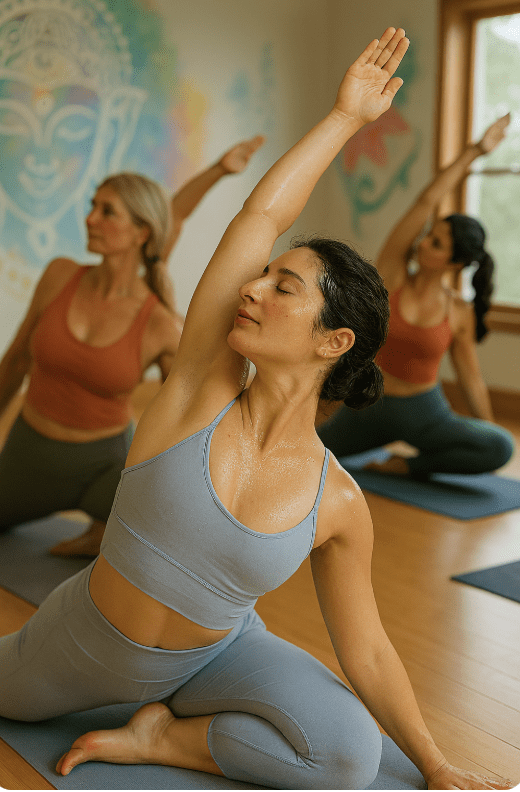
In asana practice, we often focus on the form—the lines, the stretch, the look. But when we enter shapes like Compass Pose (Parivrtta Surya Yantrasana), we are doing far more than making shapes.
We are inhabiting symbols.
We are aligning with energetic principles.
We are tuning the body, like an instrument, to the natural world.
Compass Pose literally asks us to embody the energy of a compass. It’s not just a pose—it’s a practice of orientation. Of finding our center by exploring our edges.
This is where alignment becomes more than structural—it becomes directional and intentional.
Mapping for Alignment
Mapping the body with these reference points—North, South, East, and West—helps students align in a way that transcends external cues. It invites them to orient from the inside out.
-
Lifting the heart to the East brings breath and openness to the front body.
-
Grounding the heels to the South creates stability and trust in the base.
-
Lengthening the spine toward the North draws the practitioner into clarity and lift.
-
Releasing into the West of the body supports surrender and spaciousness.
When we teach from this place, we move beyond anatomy and into embodied awareness.
Refinement and Repatterning
The body stores patterns. Through repetition, injury, habit, or belief, these patterns etch themselves into our tissues, breath, and responses.
Refinement through practice is how we begin to untangle them.
It’s how we return the body to its most intelligent state—not through force or fixing, but through reorganizing our internal compass.
This is why sequencing, cueing, and intelligent prop use matter. They help guide students back to themselves—not just to a shape, but to a state of clarity within that shape.
Samadhi: Beyond the Pattern
And when refinement is practiced long enough, it opens a doorway.
In yogic philosophy, that doorway is called Samadhi—the dissolution of false identities, the quieting of the grooves that once defined us.
It is not escape. It’s return.
To what is whole. To what is present.
To what has always been here beneath the noise.
Samadhi is not the end goal—it’s the natural outcome of remembering your own orientation.
The Body as Home
So yes—my body is my home.
It’s where I rise and fall, build and rebuild.
It’s not a pedestal. It’s not sacred stone.
It’s a place of lived experience—sweat, breath, stillness, and story.
It changes with the seasons.
It requires maintenance, attention, and love.
And just like any home, it holds me—even when I’m messy, even when I’m lost.
Through practice, I learn to return again and again.
Not to worship, but to inhabit.
Are You a Teacher Looking to Deepen Your Practice?
If you’re a yoga teacher who wants to refine your sequencing, cueing, prop usage, or assisting, I’d love to support your growth.
We have a number of upcoming trainings at Inlet Yoga designed to help teachers like you step into your voice, deepen your knowledge, and serve your students with confidence and clarity.
Reach out anytime at [email protected].
I’m always happy to connect, guide, and talk with you about your goals—because your teaching journey matters.