
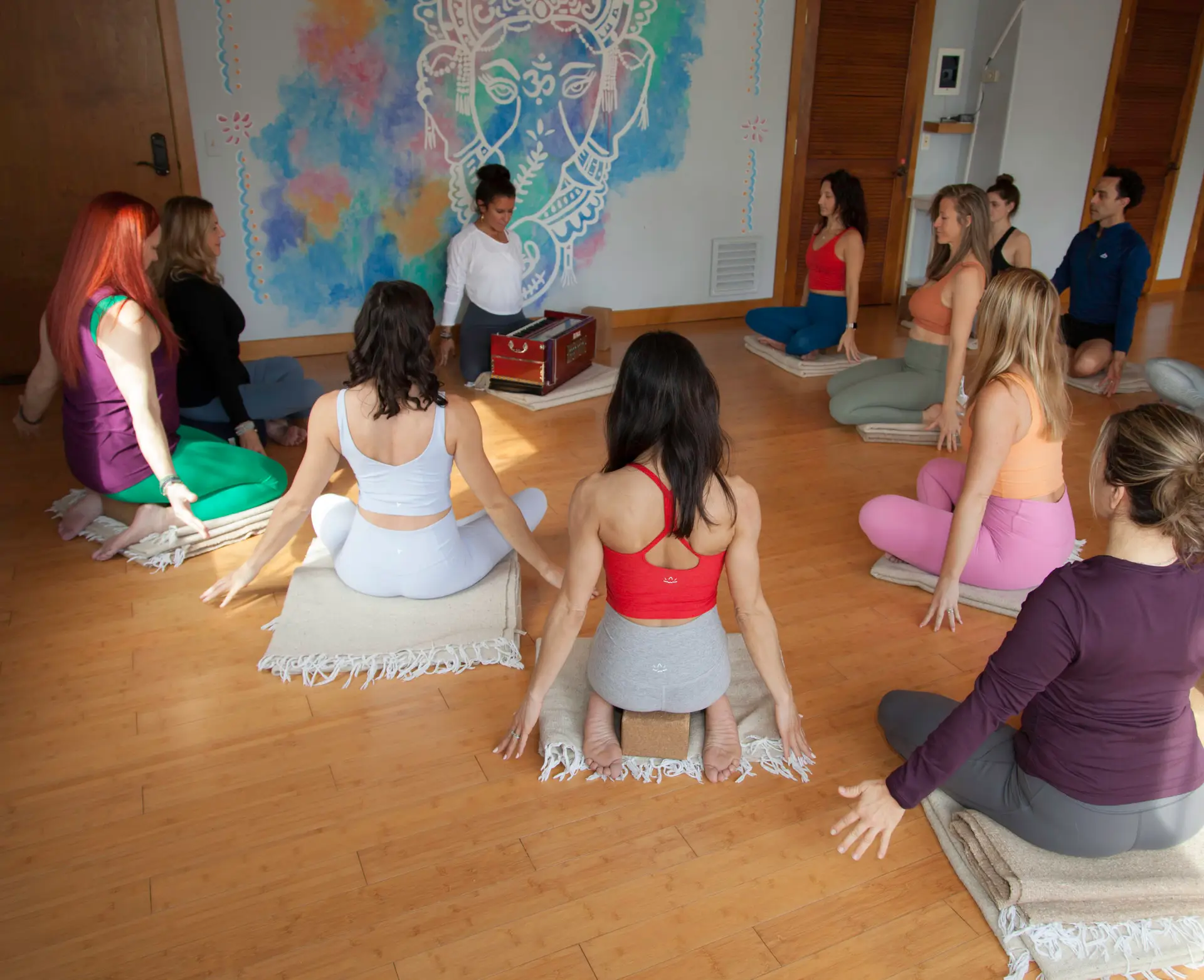
Teaching to the Student in Front of You
At a certain point in teaching, the sequence is no longer the challenge.
You know how to build a class. You understand pacing, peak pose, transitions. You’ve likely taught the same sequence enough times to feel confident in it. And for a while, that confidence serves both you and your students.
But eventually, something begins to shift.
You start to notice that the same class doesn’t land the same way every time. That what felt clear and effective one day feels flat the next. That some students are deeply supported while others seem slightly missed.
And the question becomes less about what to teach and more about teaching to the student in front of you.
Seeing Instead of Assuming
This is where the framework of the doshas becomes useful, not as a way to label students, but as a way to recognize patterns in real time.
Every student who walks into your room is arriving with a different expression of energy. Some are scattered and inconsistent. Some are driven and pushing. Some are heavy, slow, and difficult to initiate.
In Ayurvedic language, we might describe these as Vata, Pitta, and Kapha expressions, but what matters more than the label is the quality you are observing.
Because what you are seeing is not who the student is.
It is what is being expressed in that moment.
And teaching to the student in front of you means learning how to recognize those patterns quickly and clearly.
From Knowing to Responding
Many teachers are trained to design a class in advance and deliver it clearly. There is value in that. But when teaching becomes too fixed, we risk teaching at our students rather than with them.
To truly begin teaching to the student in front of you, a shift is required.
Instead of asking:
- What did I plan to teach today?
We begin asking:
- What is in front of me?
- What is needed here?
This is where the principles of Langhana (to reduce) and Brimhana (to build) become practical tools.
- If a room feels scattered or depleted, the practice may need to slow down and ground.
- If a room feels heavy or stagnant, the practice may need to build rhythm and generate energy.
- If a room feels overdriven or intense, the practice may need to soften and create space.
These are often subtle shifts, but they are what make teaching to the student in front of you effective.
Teaching to the Day, Not Just the Plan
The environment is always influencing your students.
The season. The time of year. The energy of the day. What they are carrying into the room.
In Ayurveda, these external factors shape internal experience. Which means that teaching to the student in front of you also requires teaching to the moment.
A class taught in summer may need more cooling and space.
A class in fall may need more grounding and repetition.
A room in transition may need simplicity over intensity.
This is not about abandoning structure.
It is about allowing your structure to respond to what is actually present.
An Authentic Dialogue
When you begin teaching to the student in front of you, the class shifts.
It becomes less of a performance and more of a dialogue.
Not in conversation, but in how you:
- observe
- interpret
- adjust
- respond
Students feel when they are being met.
They feel when the class is designed for them, not just delivered to them.
A Different Kind of Mastery
There is a kind of mastery in building a well-designed sequence.
But there is a deeper mastery in knowing when to shift it.
In recognizing that:
- consistency does not mean rigidity
- structure does not mean control
- and teaching is not the delivery of a plan
It is the ability to see clearly and respond with intention.
That is the heart of teaching to the student in front of you.
In Practice
This doesn’t require more complexity.
It requires:
- clearer observation
- simpler decisions
- and a willingness to adjust
You don’t need more poses.
You need a more refined ability to recognize what is in front of you, and the confidence to teach from there.






