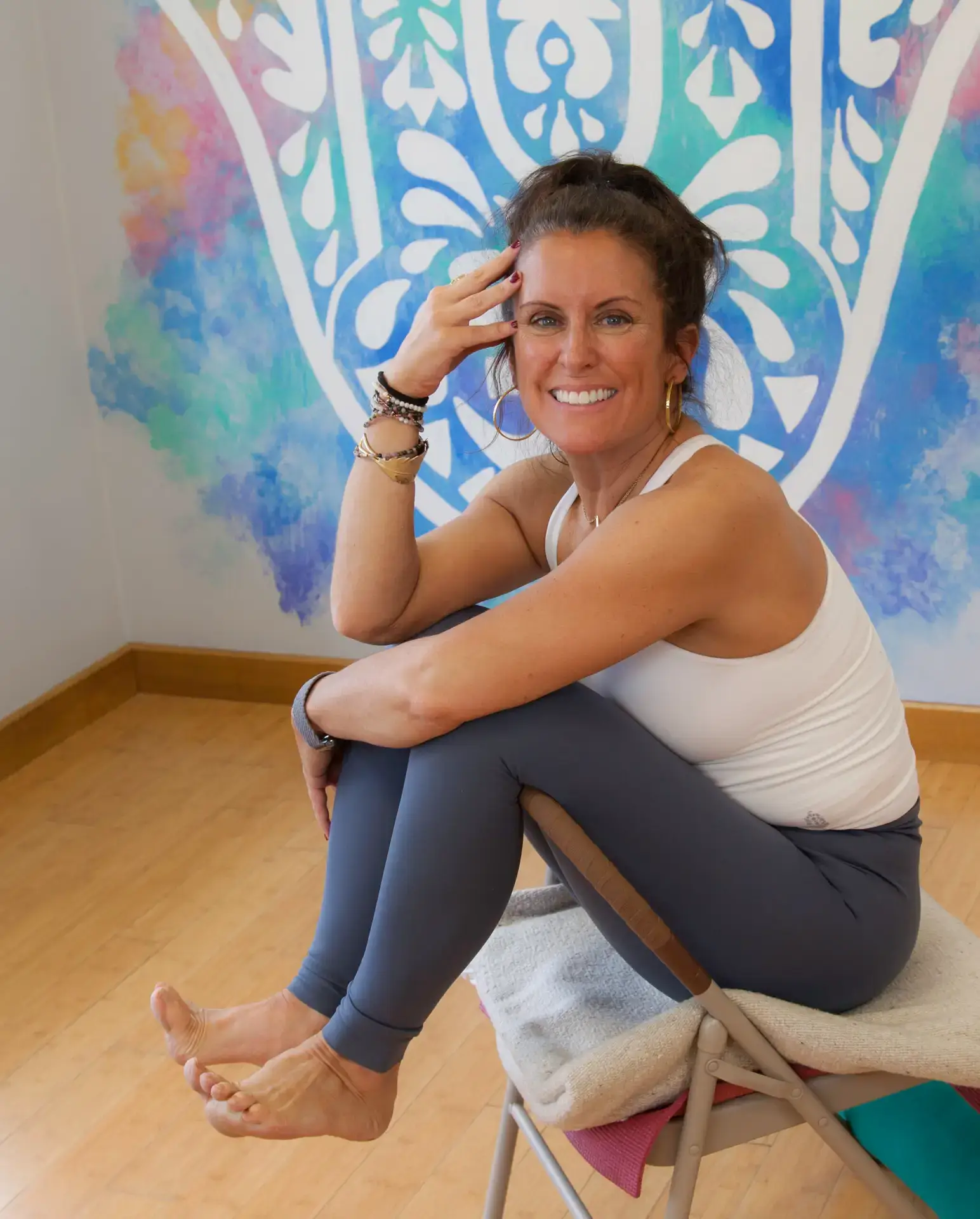
I didn’t set out to write a chair yoga book—at least not at first.
What started as a personal need, born from injury and long stretches of physical limitation, eventually became a deep passion and part of my everyday teaching. When I first began practicing chair yoga in 2018 with Mary Dana Abbott, it was after months of decompression therapy for four herniated discs. At the time, I wasn’t thinking about publishing anything. I was just trying to find a way back to my body—and honestly, a way to keep my studio going. What I discovered in that process wasn’t just a bridge back to my vinyasa practice—it was a whole new foundation. One that supported not just healing, but strength, clarity, and sustainability.
Over time, I started sharing these tools with students—some of them dealing with chronic pain, recovering from surgery, managing fatigue, or just needing something different. I noticed how chair yoga helped them not only move better, but feel more connected to themselves. And for those who thought it was “just for seniors”? That perception didn’t last long. This work goes deep—and it challenges you to meet your body exactly where it is.
What makes chair yoga intelligent isn’t the chair—it’s the way you use it. When applied with intention, a chair becomes a tool for mapping your architecture, exploring alignment, and cultivating breath awareness. It can reveal patterns, restore confidence, and offer access to shapes and transitions that might otherwise feel out of reach.
In this upcoming book, Chair Yoga for Intelligent Movement, I’ve poured in everything I’ve learned over years of personal practice, mentorship, teaching, and training. The sequences are short but powerful. The cues are clear and rooted in anatomy. And the intention is always the same: to help you move with more awareness, more ease, and more trust in your own body.
Whether you’re a student looking for a more sustainable way to practice, a yoga teacher who wants to expand your toolkit, or someone returning to the mat after time away, this book is for you. It’s not about doing less—it’s about doing better, more mindfully, and more honestly. Because a practice that meets you where you are is a practice that can support you for life.
And if you’re already a teacher or in training, this is exactly the kind of work we explore in our 300-hour program at Inlet Yoga—where we don’t just learn to teach, we learn to listen, adapt, and serve in a way that’s authentic and wise.
More to come soon, but for now—I hope you’ll stay curious.
What’s Inside the Book: A Peek at the Practice
1. Mapping the Body: A Foundation Rooted in You
One of the most transformative things we can do as yoga practitioners is learn how to see and feel ourselves clearly. That doesn’t just mean knowing the names of our bones or how a pose looks—it means understanding how our body is organized and how we experience it from the inside out.
In Chair Yoga for Intelligent Movement, we begin with this foundational work. I guide you through gentle but profound tools for body mapping—a process that connects you with your unique structure. This includes understanding your natural alignment, noticing asymmetries without judgment, and using touch (palpation), imagery, and feedback from the chair to orient yourself.
You’ll explore how the pelvis supports the spine, how to access and feel your perineum, how your breath rises through the ribs, and how small changes in posture can bring big shifts in how you feel. This is the groundwork not only for chair yoga, but for any yoga practice. And it’s one of the most valuable gifts you can give yourself as a mover, especially if you’re coming back from injury, feeling disconnected, or seeking more clarity in how you inhabit your body.
This book gives you frameworks and language that help you notice where you are and where you’re going—and it does so in a way that’s digestible and accessible. My hope is that it opens up a more compassionate relationship with your practice and your body.
Because once you know where you are, the path forward becomes a lot clearer.
2. Asana, Reimagined: Classic Shapes with a Chair-Based Lens
You’ll find many familiar postures in this book—Warrior I, Down Dog, Plank, Cat-Cow, Ardha Chandrasana—but each of them is offered with a fresh perspective: through the support and feedback of the chair.
The beauty of this approach is that the chair becomes a prop for clarity, not compromise. Rather than dilute the shape or make it “easier,” the chair invites a student to refine the action. Without the distraction of balancing or bearing full weight, you can feel more precisely what’s happening in your body—what’s engaging, what’s compensating, and where alignment can be strengthened.
Every posture in the book is given in both English and Sanskrit, and is broken down in a way that supports newer students while still offering depth for teachers and longtime practitioners. The chair allows you to slow things down, linger where there’s sensation, and build awareness from the ground up.
And for teachers, this section becomes a toolbox: you’ll see how each shape can be adapted not just for accessibility, but for developmental learning. You’ll be able to teach a room full of mixed-level students and give each one a meaningful experience—one that leaves them feeling successful, not frustrated.
These aren’t watered-down versions of yoga poses. They’re deeply intelligent pathways that remind us what the postures were always meant to be: containers for breath, awareness, and transformation.
3. Breath as Structure: The Internal Support You’ve Been Missing
Most students are told to “breathe” in yoga, but not many are taught how or why breath matters on a structural level. One of the core teachings in Chair Yoga for Intelligent Movement is that your breath isn’t just a calming tool—it’s a structural support system that plays a vital role in spinal health, core engagement, and postural awareness.
In this book, I break down diaphragmatic breathing in simple, relatable terms. You’ll learn how your breath literally supports your lower back by creating intra-abdominal pressure on the inhale, subtly activating your deep core stabilizers like the transverse abdominis. The exhale becomes a way to stabilize the spine, organize the midline, and support movement—especially in transitions and poses that require effort or lift.
This isn’t just about doing pranayama. It’s about breathing in a way that allows you to move intelligently, to lift through the pubic bone without bracing, to engage the abdominals without holding the breath, and to feel supported from the inside out.
The chair gives us feedback. It helps us stay grounded through the sitz bones and pelvis, which in turn lets the breath rise organically up the spine. And when your spine is organized and your pelvis is stable, the breath flows with ease.
I often say that in chair yoga, the lower back is not supported by the chair—it’s supported by the breath. That’s the internal shift we’re making. Once you feel that connection, something clicks. Movement becomes less effortful and more fluid. Posture becomes less about trying and more about responding.
It’s a gentle but powerful re-education of the nervous system—and once you learn it, you’ll wonder how you practiced any other way.
4. The Power of Short Sequences: Simple Practice, Real Results
One of the biggest misconceptions in yoga is that in order to feel something meaningful, we need to do an hour-long class—or flow through a hundred poses. But what I’ve seen, again and again, is that short, targeted sequences can be just as powerful, if not more so, when done with intention.
This book is built on that principle. The sequences you’ll find inside are short, effective, and purpose-driven. They’re designed to meet you where you are—whether you’ve got 10 minutes in between meetings, a busy morning before school drop-off, or a moment at the end of the day when your body just needs to come home.
You’ll find:
- Three variations of Chair Sun Salutations, depending on your goal
- A Lunge Sequence to build strength and confidence in the hips and spine
- A Half Moon + Warrior Flow for lateral strength, expansion, and balance
- A Plank Series to awaken the core and refine load-bearing mechanics
- A gentle but profound progression of Supported Backbends
- And, of course, Savasana and Legs-Up-the-Wall options to restore and reset
These aren’t “easy” sequences—they’re intelligent micro-practices that give the body just enough challenge to build resilience, and just enough structure to encourage release. They’re the kind of practices you can repeat day after day and still feel something new.
For teachers, they’re ready-to-use lesson plans. For students, they’re accessible rituals that can be woven into everyday life. Whether you’re healing, strengthening, or simply maintaining, these sequences remind you that consistency and clarity matter more than complexity.
5. More Than Movement: Healing Through Awareness
At its core, yoga has always been more than physical movement—it’s a tool for transformation, for becoming aware of the patterns that shape us, and for slowly, lovingly reworking those patterns over time.
This book honors that deeper layer. Throughout its pages, you’ll find invitations to observe—not just how your body moves, but how you feel when you move. You’ll notice how your breath responds to stillness, how your nervous system calms when your pelvis is supported, and how subtle shifts in posture can bring emotional shifts, too.
For students working through injury, illness, fatigue, or emotional stress, chair yoga offers a way back into movement that feels safe, empowering, and deeply personal. It doesn’t demand performance—it encourages presence. And when we stop trying to fix the body and instead listen to it, healing begins in earnest.
We also explore how emotional experiences show up in the physical form—tight hips, a gripping jaw, a heavy heart—and how the act of moving mindfully can release what’s been held too long. Just as you’ve likely felt butterflies in your stomach before a big event, or tight fists when you’re angry, these physical metaphors bridge a deeper understanding of self.
Yoga, especially through the lens of the chair, becomes a practice of self-study (svādhyāya). It gives you time and space to ask: How am I carrying myself today? What do I need to let go of? What do I need to feel more whole?
And that’s the heart of this book: not just helping you move better, but helping you know yourself better.
For the Student Returning to Their Body
If you’ve been away from your practice—due to injury, illness, fatigue, or just life—this book is for you.
So many students come back to yoga feeling unsure: unsure of what their bodies can do, unsure of how to begin again, unsure if they’ll ever feel like they once did. This book isn’t about getting back to who you were. It’s about rediscovering who you are now, and giving you the tools to move from this moment with grace, strength, and support.
Chair yoga is incredibly powerful for students who are in the midst of transition—whether you’re healing from something physical or navigating a shift in energy, age, or capacity. The sequences in this book are designed to help you rebuild trust with your body, one shape, one breath, and one moment at a time.
The chair offers structure and feedback. It helps you find balance when the ground feels shaky. And it reminds you that you don’t have to be flexible, strong, or “ready” to begin again. You just have to start—and start kindly.
If you’ve ever felt like traditional yoga classes move too fast, assume too much, or skip over what you need, this book will feel like coming home. And if you’re already exploring movement again, but want clearer guidance, more precision, and deeper connection to your breath, it will meet you right where you are.
You don’t need to be perfect. You just need to show up. This book will help you do that.
For the Yoga Teacher Wanting to Deepen Their Toolbox
If you’re a teacher, you know that not every student in the room needs—or even benefits from—the same approach. Some need more structure, others more space. Some need permission to slow down. And some need help finding the confidence to move again at all.
Chair yoga allows you to meet all those students—with intelligence, clarity, and compassion.
This book offers you more than sequences. It gives you a framework for seeing and teaching with greater sensitivity. You’ll learn how to adapt classic asana with a chair not as a fallback, but as a forward-thinking, skill-building tool. You’ll explore breath cues, postural adjustments, and alignment strategies that will make you a more refined teacher—whether you’re working one-on-one, teaching mixed-level classes, or leading workshops.
What I love most about teaching chair yoga is that it strips away the performance. It asks you to observe how a student functions, not how they look. That kind of teaching takes time and practice. It’s exactly what we dive into in our 300-hour teacher training at Inlet Yoga: how to teach from what you see and feel, not just what you were taught.
This book will help you begin that work—or deepen it if you’ve already started. It’s a companion piece to your continued learning, and a rich addition to your class offerings. Your students will benefit from the tools you gain here—and so will your confidence in knowing you can meet them, skillfully, wherever they are.
For Anyone Who Wants to Move Smarter, Not Harder
You don’t need to be injured, advanced, or even experienced in yoga to benefit from this book. What you do need is the desire to move in a way that feels good—and continues to feel good for years to come.
Chair yoga isn’t about limitations. It’s about sustainability. It’s a way to build strength, mobility, and awareness without creating unnecessary stress on the body. The sequences in this book may be done from a chair, but they’re far from passive. They challenge your attention. They ask you to move with clarity. And they offer the kind of precision that, once felt, transforms how you practice on the mat, in life, and everywhere in between.
This book is for you if:
- You want shorter, efficient practices that still feel like real yoga
- You’re curious about alignment, breath, and movement that’s truly functional
- You’re looking for a reset—a way to reconnect with your body in a deeper way
- You’ve outgrown “pushing through” and want to move more mindfully
The truth is, our bodies are always changing. Whether you’re in your 30s, 50s, or 70s, your body deserves a practice that can evolve with you, not against you. Chair Yoga for Intelligent Movement helps you build that practice with patience, joy, and curiosity.
And if you’re the kind of person who values longevity over aesthetics, embodiment over image, and insight over intensity—this is your book. And this may be your next step in the practice.
Why This Book Matters Right Now
We’re living in a time when it’s easy to disconnect from our bodies. We sit more. We rush more. We push through. And somewhere along the way, we forget that our bodies are not machines—they are living, responsive, ever-changing containers for our experience.
I wrote Chair Yoga for Intelligent Movement because I believe the body deserves a practice that evolves with it. Not one that demands perfection or performance, but one that honors sensation, alignment, breath, and the wisdom of subtlety.
Chair yoga is often misunderstood—labeled as “gentle” or “just for older adults”—but this book shows otherwise. It proves that chair yoga is an intelligent, effective, and deeply refined approach to movement that every practitioner and teacher can benefit from. Especially right now.
Why now? Because we’re at a turning point in how we think about wellness and movement. More and more people are waking up to the fact that sustainability matters. That alignment matters. That nervous system regulation, breath integration, and postural awareness aren’t just “extras”—they’re everything.
This book offers a solution that’s practical, accessible, and profound. It meets you where you are—whether that’s on the edge of burnout, the brink of recovery, or in a space of deep curiosity about how to live and move well in the body you have right now.
We don’t need more pressure to push harder. We need practices that teach us how to listen better. That’s exactly what this book offers—and why it matters, more than ever, to bring it into your hands and your practice.
It’s Time to Move Smarter—Start Now
If you’re a student who wants to reconnect with your body, a teacher ready to grow your skill set, or a human who’s done with grinding through movement that doesn’t serve you—it’s time.
Here’s what you can do right now:
- Join the waitlist to be the first to know when Chair Yoga for Intelligent Movement drops
- Get on the interest list for our next Chair Yoga Training at Inlet Yoga
- Book a call with me to talk about whether the 300-hour teacher training is the next right step in your journey
No fluff. No vague “someday.” If this spoke to you—follow the pull.
Because here’s the thing:
Every day you wait to make your practice sustainable, to deepen your teaching, or to reclaim your movement… is a day you don’t get back.
Let’s stop waiting. Let’s start moving—smarter, kinder, and with intention.
I can’t wait to walk with you.